
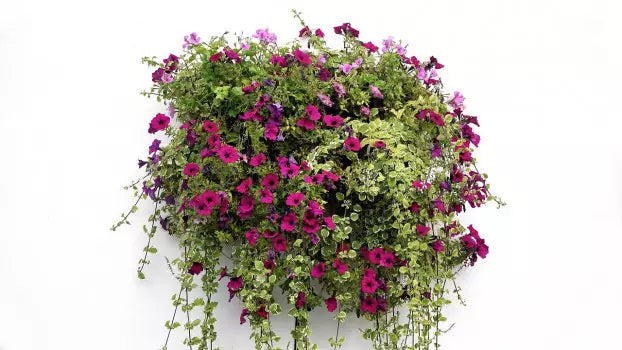
To create a vertical garden, you can contact various technical companies in the sector. This is at least necessary, because installation on the facades of buildings or on walls whose dimensions are large is not easy. If you want to create an indoor garden, then there are simple do-it-yourself ways, which are also very economical.
One of the most immediate and DIY systems for the vertical garden is that of pockets, into which the plants are inserted. They are real felt panels on which pockets are structured, specifically designed to contain various plant substances, with different sizes and consistencies. The pockets are usually made with a moisture-resistant material, so it is possible to apply them to different wall surfaces without the risk of mold formation. Alternatively, it is possible to choose surface pots, designed specifically for the interiors of vertical gardens: an insulating substrate for the plant is applied inside these pots. After inserting the plant, apply the appropriate hooks to the wall, which will support the weight of the pot and the plant. On the market you can find containers whose dimensions are various and different and it is strongly discouraged to use half plastic bottles, which would dry out the roots and would not revive the plant itself.
In some limited cases, if the garden must be created inside a balcony, it is possible to choose pallets, which must be thought of as supports for the plant pots, which will be fixed between one slat and the next. For this specific type of surface, we recommend small plants that can be easily supported and which can also bear small fruits for your kitchen, such as strawberries or cherry tomatoes.
Faced with all this beauty you have to take into account the costs, which depend entirely on the size of your vertical garden. The most purchased panels, i.e. the 80x60 cm ones, cost around 80 euros, to which the cost of the soil and seedlings must be added, which can change from case to case. It is also true that today there is no shortage of DIY solutions, in fact on the market you can find many economical and practical solutions to maintain your garden. Finally, thanks to the green push of recent times, in some countries the creation of vertical gardens is encouraged, thanks to important tax deductions designed for frequent growth of urban greenery.
How do you care for a vertical garden?
The idea of verticality can, at first, be scary. Perhaps because the idea of always taking the ladder to water our friends creates doubts about safety. There is no need to be afraid of this problem, because irrigation systems designed for vertical gardens today are reduced to the activation of a simple button. It should also be noted that the cultivation method chosen for the verticalized greenery is the same as for the horizontal one: there is a base of soil which, with the system mentioned above or with a spray bottle, is periodically irritated. In parallel to the classic soil, there are those who use the drip hydroponic system, i.e. a system applied to the highest part of the garden for which, instead of soil, a mixture of coconut fibre, expanded clay and perlite is used. The hydroponic system is often the most appreciated, because it allows many solutions, which allow a strong adaptability of the numerous surfaces and supports that are used to create the garden.
However, even before maintaining your garden it would be advisable to select the plants: this destination changes based on the climatic conditions of the environment in which you want to create the garden, on the basis of the exposure in that area and in relation to ventilation. Examples are climbing plants, which are capable of growing quickly in height, and cascading plants, which instead grow downwards. If you don't like these two types very much, you can always choose small plants that are always green and whose growth is limited, so that the commitment and maintenance towards the garden can be limited during the week.
The kitchen is highly popular as an environment in which to create the garden: this is because it is possible to populate the vertical garden with aromatic herbs such as sage, lavender, rosemary and lemon verbena. This mix creates an incredible variety of aromas and culinary benefits. However, this aromatic herb is just a gem, because generally for vertical gardens resistant plants such as ferns, philodendrus and ficus are selected, i.e. species that survive adverse climatic conditions.
The benefits of gardening: what is a vertical garden?
Loving greenery is not limited to watering it plants all year round or to find the right vase for the new poinsettia, but it means continually caring and studying our beloved roommates. Often having an exterior would seem to be a fundamental requirement for being able to take care of plants but, thanks to the latest frontiers in gardening, the concept of vertical forest and vertical garden are increasingly advancing within people's domestic spaces. In fact, if you don't have a lot of space but you have a good dose of enthusiasm for taking care of the greenery, you need not fear, because your favorite plants can be easily grown thanks to constant care and small precautions. Creating a vertical garden is not only an achievement for those who don't have an outside, but it represents a real panacea for one's mind and for the elegance of the home environment. This is because the concept of a vertical garden implies a planning and layout that can give those who create it a real methodology to the problems. In fact, Herman Hesse said "It is not easy to have a beautiful garden: it is as difficult as governing a kingdom". But what specifically is a vertical garden? It is a real project that has become part of the domestic life of many European environments in recent years, especially in the most avant-garde spaces. The vertical garden contains numerous compositions and plants of different origins and species. The plants are positioned in specific pots, which are fixed using special panels or anchored to the external or internal wall of the load-bearing structure. Vertical gardens are highly appreciated not only for their heterogeneous concentration of plants, but also because they represent a type of setup highly adaptable to all types of environments: they can be found inside rooms, inside homes or residences, inside open space spaces and even inside public structures. Its versatility is unmatched and, precisely for this reason, it is so widespread in cities with numerous skyscrapers.


