
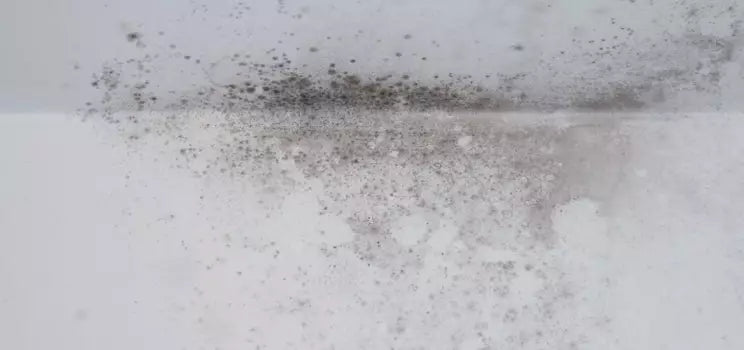
Autumn is the season of changes and new colors and, very often, in the home this means a new color for your walls. When you call the gilder, one of the first issues he has to deal with concerns mould, an annoying and harmful enemy for the individuals who live in the house. When mold appears, it is necessary to intervene promptly because its spread could create serious problems. At the first mold stains it is necessary to intervene, because as a progressive phenomenon, it could also turn out to be the consequence of serious structural problems. Before painting your house you need to carry out a careful inspection of the walls, intervene on the mold and only at the end intervene with the colour. But why does mold appear? Mold is a real living roommate, an organism that grows and feeds and which should not be treated as a simple stain. Mold reproduces, and this is why it must be understood as a dangerous phenomenon: around 50,000 spores can nest in a small black surface, each of which can generate millions of new organisms. All of this is highly unsanitary, scary and grows proportionally to the humidity of the environment in which it is found. Let's see, then, how to remove mold on walls!
The management of mold on the walls
There are essentially two steps to take when you notice the mold that has been generated. Firstly, it is necessary to eliminate the outermost layer of the mold and, immediately afterwards, understand the origin of the mold itself, analyzing the cause that caused its formation.
To superficially eliminate mold you need to remove stains with bicarbonate: this must be thought of as a natural whitening detergent, thanks to 2 generous spoons of bicarbonate diluted in hot water, you can obtain your own natural disinfectant. This will begin to threaten the mold's resistance. Even a mixture of bicarbonate, water and lemon juice can give rise to new solutions, creating a natural antibacterial shield. The mixture should be left to rest directly on the wall for a few minutes.
After the bicarbonate, place the vinegar, which must be diluted in approximately one and a half liters of hot water: use a spray nozzle to spray the mixture on the wall and remove the mold with a disposable cloth.
Finally, a strong and immediate solution is bleach, for the most difficult stains to remove. Even though bicarbonate of soda and vinegar are excellent allies, the artificial power of bleach has no equal in terms of stain removal. A solution based on water and bleach, left on for 30 minutes, will remove all possible and imaginable stains, but you must carry out the operation several times before obtaining a brilliant effect. Finally, it is always advisable, during this treatment, to use special gloves and a mask, keeping the windows open and allowing continuous air recycling, because bleach remains a substance that should not be inhaled.
Before painting the walls: what to do?
To create a shield against possible unpleasant returns, hydrogen peroxide can also be applied, which represents a solution 10 times more advantageous than bicarbonate and vinegar. Alternatively, if you always want to follow the home-made route, then you can try essential tea oil: thanks to the antibacterial properties of which it is made and thanks to its anti-fungal abilities, tea tree oil is a valid remedy against the growth of mold. The mixture must be made with 100ml of vinegar, about 13 drops of oil and, finally, the mixture must be sprayed on the wall waiting for it to take effect.
Aggressive solutions against mold: how to eliminate it with chemicals?
If you don't really like natural methods, then you can use more aggressive products. All so-called "chemical" products whose basic component is sodium hypochlorite are excellent for acting against fungi, algae and mold on walls. These formulas, which are usually ready for application, are spread along the contaminated surface and left to rest for approximately 48 hours. After the microflora has been killed, it is necessary to intervene by vigorously brushing the excess layers and removing every single residue, before starting to paint your room.
The pre-painting anti-mold protocol: what to do?
Having reached this point we need to move from theory to practice and act on the opportunity to finally paint our walls. After eliminating mold it is always advisable to activate a curative and simultaneously preventive strategy. After elimination, it will be necessary to apply, using the roller tool, a wall sanitizer that can eliminate infestations and prevent new proliferations. After which you must clean the wall and carefully sand the affected surface. Next it will be necessary to apply a product with fixative, acrylic and properties anti-mold, facilitating the absorption of the future paint that will be applied.
After having carried out this long and laborious procedure, it is necessary to take action to ensure that the mold does not recur and, therefore, to keep the humidity below the 55% threshold. How? By keeping your environment in continuous air recycling, letting in sunlight, because mold loves the dark very much, and not causing forced temperature changes.
It may seem trivial, but it is precisely these small everyday precautions that prevent the management of a persistent and long-to-treat problem such as the presence of mold. Unless there are broken pipes or serious structural problems, avoiding rising humidity in your home is really child's play. And are you ready to paint the whole house again and give it a fresh and clean taste?


